

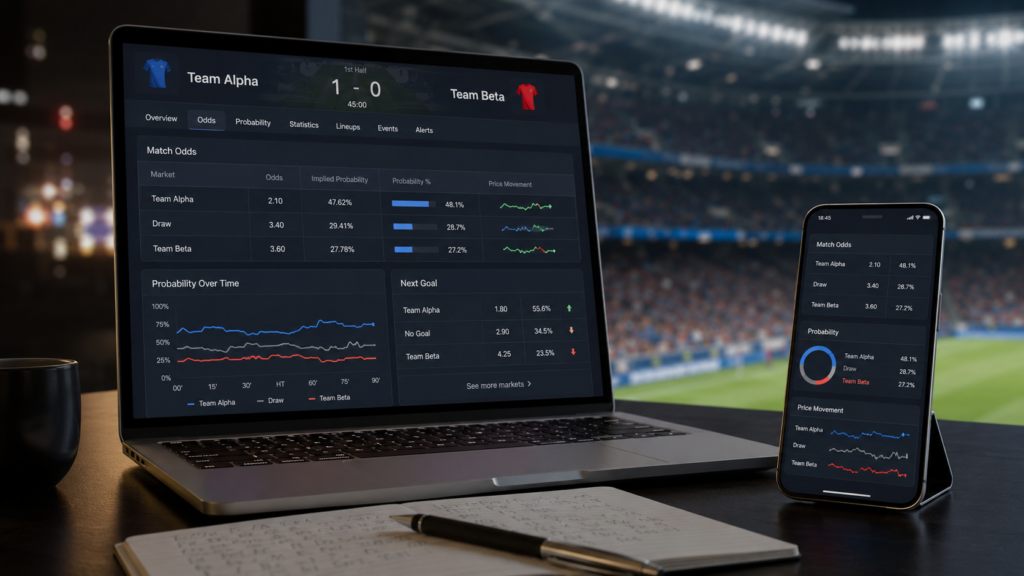
A football match can end in one of three main outcomes, but the numbers displayed beside each team can communicate a great deal of information. Football odds are more than simple figures. They represent estimated probabilities, calculations made by odds providers, and market information that may change before the match begins.
Understanding these principles helps readers interpret football markets without relying on assumptions or common misconceptions.
People who search for football odds platforms like ufabet login often want to understand how match prices are calculated before accessing sports information services. Knowledge of probability and market movements provides an essential foundation for reading odds responsibly and understanding why the displayed figures rarely remain unchanged after their initial release.
The Real Meaning of Football Odds
Fundamentally, football odds represent the estimated likelihood of a particular outcome. Odds providers calculate these figures by considering available data and adding an operating margin.
Odds do not provide a guaranteed prediction. Instead, they express the probability of an event based on the information available at a particular time.
Decimal odds are widely used in international football markets. Lower odds generally indicate that an outcome is considered more likely, while higher odds suggest that an outcome is considered less likely.
| Decimal Odds | Implied Probability |
|---|---|
| 1.50 | 66.7% |
| 2.00 | 50.0% |
| 3.00 | 33.3% |
| 5.00 | 20.0% |
The implied probability can be calculated by dividing 1 by the decimal odds and multiplying the result by 100.
For example:
1 ÷ 2.00 × 100 = 50%
This calculation helps readers understand the market’s estimated likelihood of a specific result.
Why Odds Providers Include a Margin
Odds providers do not simply convert probability into prices. They usually include an operating margin, commonly known as an overround. This causes the combined implied probability of all possible outcomes to exceed 100%.
Consider a market with two possible outcomes, each having a theoretical probability of 50%. The fair decimal odds for both outcomes would be 2.00. However, an odds provider might display both outcomes at 1.91.
The difference between the fair price and the displayed price represents the provider’s operating margin.
Several points are important to understand.
Higher margins generally result in less favorable market prices.
Margins may vary between sports, competitions, and market categories.
Comparing prices can help readers understand why different platforms display different figures for the same event.
The margin does not necessarily indicate that the provider expects one particular result. It is primarily part of the platform’s pricing and risk management system.
Why Do Odds Move Before Kick Off?
Football odds rarely remain constant because providers continuously respond to new information and changing market conditions. A movement in price does not automatically mean that the final result has become certain.
Several factors may influence price movements.
Team news, injuries, and player suspensions can affect expectations.
Weather conditions may influence how a match is expected to develop.
Changes in the predicted starting lineup can alter assessments of team strength.
Large changes in audience interest may affect how providers manage their financial exposure.
New statistical information can also influence probability models.
Market movement should therefore be interpreted as an indication that information or market conditions have changed. It should not be treated as proof of what will happen during the match.
For example, the absence of an important striker may cause the estimated probability of a team winning to decrease. However, that team may still win because football results depend on many unpredictable factors.
Understanding Different Odds Formats
Football odds appear in several formats around the world. Although the presentation differs, each format communicates an estimate of probability.
| Format | Example | General Meaning |
|---|---|---|
| Decimal | 2.50 | Total calculated value per reference unit |
| Fractional | 3/2 | Potential gain relative to the reference amount |
| American | +150 | Calculated gain based on a standard reference amount |
Decimal odds are common in Europe, Asia, and many international platforms. Fractional odds are traditionally associated with the United Kingdom, while American odds are commonly used in the United States.
Understanding these formats can help readers compare market information from different regions. However, learning how to calculate implied probability is often more useful than memorizing every format.
Probability provides a universal method for interpreting what the figures suggest about market expectations.
Common Myths About Football Odds
One common misconception is that odds can predict the future. In reality, odds only represent estimated probabilities based on currently available information.
Even an outcome with an implied probability of 80% can fail to occur. Probability describes likelihood rather than certainty.
Another misconception is that every price movement must result from important team information. In practice, prices can also move because providers are adjusting their exposure across different outcomes.
A third misconception is that lower odds always represent a better choice. Lower odds merely indicate that an outcome is considered more likely according to current information. They do not guarantee that the event will happen.
Some readers also assume that all platforms calculate prices in exactly the same way. However, providers may use different data sources, probability models, operating margins, and risk management methods. These differences explain why the same match may have slightly different prices across multiple sports information platforms.
The Importance of Responsible Interpretation
Football odds should primarily be viewed as statistical information. They provide insight into how a market evaluates teams, players, and possible match outcomes.
Readers should avoid interpreting odds as financial advice or guaranteed predictions. Football contains many unpredictable variables, including individual mistakes, refereeing decisions, tactical changes, injuries during the game, and unexpected weather conditions.
Responsible interpretation begins with understanding that probability is not certainty. It also requires readers to comply with the laws and regulations applicable in their respective countries.
Sports information platforms like ufabet should be used carefully and only for lawful purposes. Users should also review the terms, licensing information, age restrictions, and consumer protection policies of any platform they access.
Frequently Asked Questions
What is implied probability?
Implied probability is the percentage likelihood of an outcome suggested by the displayed odds. It can be calculated by dividing 1 by the decimal odds and multiplying the result by 100.
Why do football odds change before matches?
Odds may change when providers respond to team news, injuries, weather conditions, lineup changes, statistical updates, and shifts in market activity.
What is the provider margin?
The provider margin, also called the overround, is the difference between theoretical fair probabilities and the prices displayed by the platform. It supports the provider’s operations and helps manage financial exposure across multiple outcomes.
Are lower odds always better?
No. Lower odds only indicate that an outcome is considered more likely according to current market information. They do not guarantee that the outcome will occur.
Do odds accurately predict football results?
Odds provide probability estimates rather than certain predictions. Unexpected events can significantly influence the final result of any football match.
What Really Matters
Football match odds combine probability, provider margins, statistical analysis, and changing information into a single set of figures. Understanding these concepts makes football markets easier to interpret and helps readers avoid common misconceptions.
Rather than treating odds as promises, readers should view them as changing estimates based on available evidence. Team news, player availability, market activity, and provider calculations can all influence the figures displayed before kick off.
A basic understanding of probability therefore provides a clearer and more responsible way to interpret football odds website like ufabet. It allows readers to understand what the numbers represent without assuming that they can guarantee the outcome of a match.
