

Most people approach AI music tools with two competing hopes. They want the process to be simple, but they also want the result to feel personal. That tension is what makes this category difficult. Simplicity often removes control, while control often slows everything down. In that sense, reviewing AI Music Generator is really a question of balance. Can a browser-based music platform stay approachable without becoming generic? Can it support musical direction without turning into a technical maze?
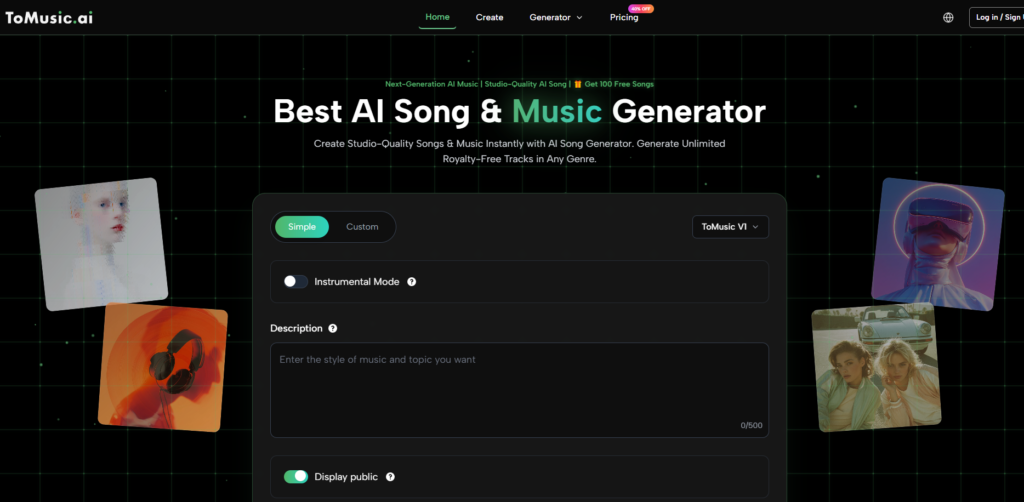
After examining ToMusic’s public workflow, I think the answer is more positive than skeptical. The platform does not behave like a deep production suite, and it does not pretend to be one. Instead, it tries to give the user a manageable number of levers: mode selection, style input, lyric input, and classification tags such as genre, mood, voice, and tempo. That may sound ordinary, but in practice it changes the quality of interaction. It turns generation from a loose wish into a partially directed process.
Why Control Is The Real Review Question
A lot of reviews in this space focus too much on whether the first output sounds impressive. That is understandable, but it can be misleading. The better question is whether the tool helps users shape an output over repeated tries. First results are interesting. Repeatable direction is useful.
Good Tools Narrow The Gap Between Intent And Output
That gap is where most creative frustration lives. A user may know they want something dreamy, slow, female-led, and emotionally restrained. If the product offers only one open prompt box, the result depends heavily on how well the model infers hidden preferences. When a platform offers more structure, it lowers the chance that your idea stays trapped in your head.
Structured Inputs Usually Produce Better Creative Behavior
ToMusic’s creation layout points in that direction. The presence of title, styles, lyrics, and tagged musical traits signals that the platform is trying to capture intent through multiple channels. In my view, that is one of its best design choices.
The Interface Encourages Musical Specificity
The most encouraging part of the product is that it does not reduce music generation to a single sentence prompt. That matters because music is multidimensional. Genre is not the same as mood. Voice is not the same as tempo. Lyrics are not the same as arrangement.
Simple Mode Helps People Start Without Overthinking
Some users need a low-pressure entry point. The Simple option seems designed for that case. It is useful for quick tests, rough mood checks, or anyone who wants to go from idea to first audio draft with minimal setup.
Custom Mode Suggests A More Intentional Workflow
The Custom path appears to be where the platform becomes more serious. Here, the relationship between style direction and lyric content matters more. For people who care about shaping the result rather than only receiving it, this is probably the stronger route.
Instrumental Mode Broadens The Product’s Utility
A platform that forces vocals on every user becomes narrow very quickly. The instrumental option makes ToMusic more versatile because many users are not writing songs with words. They are making music for video, podcasts, ad concepts, background loops, or emotional pacing.
How The Official Workflow Supports Control
The clearest way to understand the product is to look at the path it gives users. The process remains short, but each step has a specific purpose.
Step One Defines The Creative Direction
Users begin by choosing a mode, which already reduces ambiguity. Starting with Simple, Custom, or Instrumental means the system is not treating every request as the same problem.
Step Two Adds Layered Musical Instructions
The next stage is where the platform earns its credibility. Title, styles, and lyrics are visible fields, while genre, mood, voice, and tempo act like guiding constraints. This is a more thoughtful setup than tools that ask users to guess the whole song in one paragraph.
Step Three Generates A Song Draft
After the inputs are set, the platform moves into generation. This step is intentionally short, which supports experimentation. A creative product becomes more valuable when it encourages multiple tries instead of making each try feel expensive.
Step Four Organizes Results For Review
The My Music Studio area matters because generated music rarely lives as a single final answer. A storage and review layer supports comparison, selection, and practical reuse.
What Stands Out In Terms Of Creative Range
The platform’s broader music positioning is not just about one generator page. It also presents multiple specialized generation tools, which suggests that the product team sees demand across different emotional and thematic use cases.
Specialized Generators Help Non-Musicians Start Faster
Story songs, weather songs, dream songs, vlog music, quotes to music, and similar variants may sound promotional at first. But they also perform an important function: they reduce decision fatigue. When a user sees a frame that matches their need, it becomes easier to begin.
This Matters For Real Creative Work
In practical content workflows, the hardest part is often not the final polish. It is starting with enough direction that a test result becomes possible. A good creative product lowers that starting threshold.
How Strong Is The Output Potential
No responsible review should claim guaranteed quality from AI music. The better approach is to ask what kind of output potential the interface and model structure imply.
The Multi-Model System Is A Good Sign
The pricing structure and plan descriptions suggest access to a family of models, including a tiered range from standard quality toward stronger vocal capability in higher versions. In my observation, multi-model availability often leads to better product maturity because it accepts that one model may not serve every need equally well.
Longer Song Support Expands Serious Use Cases
The paid plan language includes support for longer song duration, up to eight minutes in certain plans. That is useful because many shallow generators top out before the music has room to develop. Longer duration does not guarantee better composition, but it does make the platform more relevant to extended content.
Export Flexibility Improves Practical Use
The availability of MP3 and WAV downloads, along with stem extraction and vocal-removal tools in the paid structure, pushes the product beyond novelty. Those are the kinds of functions people look for when they intend to reuse, edit, or repurpose output.
Where The Platform Feels Strongest In Practice
The product is not equally suited to every kind of musical ambition. Its strengths are clearer in certain contexts.
| Use Case | Fit Level | Reason |
| Social content music | Strong | Fast drafting and style flexibility |
| Branded jingles | Strong | Lyric and mood direction help |
| Background score tests | Strong | Instrumental option is practical |
| Songwriting exploration | Moderate to strong | Good for drafts, less certain for final polish |
| High-end studio replacement | Limited | Still requires human judgment |
What Users Should Be Honest About
A trustworthy review needs limits. Tools like this become disappointing when people expect them to remove the need for taste.
Direction Quality Still Matters
The platform gives users several control points, but the quality of the result still depends on the clarity of the request. A vague style line usually leads to a vague output. Better prompts and better lyrical framing will probably improve outcomes.
Generation Does Not Remove Curation
In my testing mindset, the real work shifts rather than disappears. Instead of manually building every note, the user curates, retries, and compares. That is faster than traditional composition in many situations, but it is still creative labor.
Flagship Claims Need Realistic Expectations
The site’s language around studio-quality output and top-tier vocals is ambitious. Some results may indeed sound surprisingly polished. Still, users should approach those claims as directional rather than absolute. Real quality is always context-sensitive.
How The Product Feels For Different Skill Levels
One reason ToMusic is easier to review positively is that it does not seem designed only for experts.
Beginners Get A Low-Friction Entry Point
A newcomer can use the free tier, generate early drafts, and learn what kinds of wording shape better songs. That is an accessible way to enter AI music without purchasing a full production stack.
Intermediate Users Get Useful Control Without Excess Complexity
This may be the strongest audience fit. People who understand genre, tone, tempo, and lyric intent will likely benefit most because the platform gives them enough control to steer output without overwhelming them.
Advanced Users May Treat It As A Draft Engine
Experienced music makers may still prefer conventional tools for final refinement, but that does not make ToMusic irrelevant. It may still be valuable for ideation, mood testing, and lyric-based sketching.
The Value Question Is More Nuanced Than Price Alone
The cost of a music tool is not only what you pay. It is also how many attempts you need before reaching something usable.
The Free Plan Makes Discovery Easier
A one-time allocation of 100 songs is a meaningful invitation. It gives users enough room to test styles, compare prompt strategies, and decide whether the workflow fits their own creative habits.

Paid Plans Add Workflow Depth
Additional models, longer song lengths, private generation, concurrent jobs, WAV export, and stem utilities are practical reasons to upgrade. They matter most for users who are already generating frequently.
Parallel Generations Can Change Team Speed
For collaborative or deadline-based work, concurrency is not a minor detail. It can reduce waiting and make A/B testing more realistic inside one session.
My Overall Judgment On To Music
ToMusic does not stand out because it promises impossible perfection. It stands out because it respects a real creative truth: people often need structure more than spectacle. The platform’s strongest quality is not that it generates songs at all. Many products do that now. Its stronger quality is that it gives users a clearer path for turning rough ideas into directed experiments.
That is why the phrase Text to Music feels central to the review. The product is not merely converting words into sound in a mechanical sense. At its best, it is converting partial intent into a workable draft. That is a more meaningful creative service.
The limitations remain real. Results will vary. Some outputs will need retries. Some users will want more arrangement precision than a browser tool can offer. But as a controlled drafting environment for modern creators, ToMusic is more thoughtful than casual first impressions might suggest. It deserves attention not because it simplifies music into a trick, but because it makes early-stage musical exploration easier to repeat, compare, and use.
